Feeds:
Posts
Comments

I’ve already blogged about how much I like Tasia at Sewaholic; well, here is a quick review of some of her patterns! As I mentioned in the blog review, the Sewaholic line is designed for pear-shaped ladies and so is designed with style details to flatter and also to fit the pear. The trouble is her designs are so amazing those of us who are not pear-shaped are desperate to alter, tuck and rework our way into those lovely items too!

Tasia’s Pendrell – image from the Sewaholic pattern store

The Sewaholic line currently consists of five patterns, although Tasia is adding it to it all the time. First up were the Crescent skirt (below) and the Pendrell blouse (above) which immediately took the sewing blogosphere by storm. I’ve made two versions of the Pendrell myself and love them both. I like the shape of the design although I have to make it a bit more tailored to suit my frame, but what I especially love is the construction details – the instructions for the view Tasia is modelling above contain the best guidance for an armhole facing I have ever seen.

Next up was the Lonsdale dress, modelled by member Roisin, below. This dress comes in two lengths, with a lovely knot tie detail at the front. Roisin said it was a dream to sew – and it even has pockets! She also agrees that it’s an ‘easy’ pattern despite how gorgeous it looks.

The other Sewaholic pattern I’ve made is the Minoru jacket which was launched last autumn. It was designed with cyclists in mind, and since I cycle a lot, and had been eyeing up some similar jackets, I snapped up the pattern immediately.

Again, despite how great it looks it’s very do-able, and as for all the other patterns, there is a sewalong on Tasia’s blog if you want a bit of extra support. I used some pretty cheap cotton drill type fabric as I wanted to try out quite a few adjustments but I jazzed it up a bit by adding piping down the front. I also lined the hood (which rolls up into its own zipped pocket) and added some in-seam pockets. There are inside pockets already in the pattern for keeping your keys and phone. Again, I loved the finish and the instructions and even though I’m not sure that my adjustments worked out 100% I get such a kick out of wearing it. I’m already planning another in a more exciting fabric.

Finally, Tasia has just launched a jersey knit top called the Renfrew – we’d love a review if any of you try it!

Sewaholic patterns are available at sewbox and other sites in the UK.

Kate: Felt Decorations

In a burst of productivity, I managed to finish the decorations set which I have had knocking about since Oct 2009 in just one month! These are from Alicia Paulson’s Rosy Little Things webshop and I love them.

This was my first time working with beads. I had expected it to be really fiddly but in fact, I found it quite gratifying to work with the pretty beads and sequins which look so good against the felt. The patterns are so easy to follow and you can choose how closely you follow them. I chose not to make my cottage two-sided as I had just had enough of the process and where I hang them, you can’t see the back anyway.  I can always add more features at a later date and there was plenty left-over felt, thread and beads so cover any mistakes and bolster my embroidery stash!

I need a break from Christmas decorations now so I am off to tackle something else from my Make List. Perhaps I will quilt my maple leaf block for my sampler quilt or maybe I will start designing the wall hanging for our lounge which will be inspired by this one. I have already bought the fabric which includes the one below from the Circa 1934 by Cosmo Cricket range for Moda Fabrics.


Craft shows are a great way of getting inspired in a craft you already love, learning about new crafts and finding all kinds of great fabrics and notions.  There are a couple of big craft shows coming up this March. First there is Stitch and Craft at Olympia in London from the 15 – 18 March. This show covers knitting, cross stitch and papercrafts. As part of the show a miniature knitted village is being created, you can participate by knitting something for the village, patterns are available here. You have until 24 February to submit your entry and until 1st March to get your creations to them. Or you could just go along to the show and enjoy the finished village.

You will also be able to see a special exhibition of over 500 quilts that have been made to celebrate the Olympics.

The second show is on at the NEC in Birmingham, which is easier for most sew make believe members to get to than London. This show is on from 22 – 25 March. This show incorporates Sewing for Pleasure, Hobbycrafts, and Fashion Embroidery and Stitch, click here for more details.

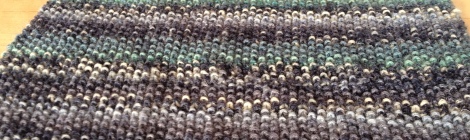
This project started out as a way to use up scraps of wool. This is why some of the squares are striped, some have borders… and no two are identical!

I intended to crochet 64 squares to make an 8×8 blanket… but I ran short of patience! I desperately wanted to be finished before the cold snap, so 49 squares sufficed. 7×7 is still a pretty decent size!

That stripy square in the middle is my favourite!

I can’t believe how warm these blankets are, despite many of the squares being end-of-ball polyester wools. They really trap the heat in and create a cosy cocoon around the body.

I will no doubt be getting a lot of use from this baby before winter breaks!

Zoë: Tie Cushion

I have made a cushion by recycling some of my husband’s old ties. These were ones he no longer liked or those that had seen better days. I was inspired by the book The Shirt off His Back that I reviewed recently. As well as a big pile of old shirts to use, I had quite a collection of ties! I had also seen a pattern to make a cushion from ties in Sew Eco magazine, but I was put off this project as you had to deconstruct the ties first. I didn’t want to do more than a little bit of cutting. Here is how I made this cushion:

First cut the ties into lengths; mine were 50cm long for a 40cm cushion pad. I left plenty of extra length so the edges could be tidied up at the end. I was able to get two pieces from each tie. Lay out the pieces so the diagonals sit together to make a roughly square panel.

Lay the pieces side by side on the sewing machine (rather than overlapping them) and zig zag to hold them together, this is really quick and works really well. I used thread in a contrasting colour to make it look more interesting.

Trim the edges of the panel to make a square slightly bigger than your intended cushion pad. I made mine 42cm for a 40cm cushion pad. This is to leave some seam allowance.

Cut out a panel for the back from an old shirt. Use the buttons down the middle for an instant opening with no extra work. Old shirts are brilliant for cushion backs.

Lay right sides of the shirt and tie panel together and stitch all the way round. Clip corners, the turn the cover the right way out.

Place the finished cushion on your favourite chair, sit back, and relax!


Zoë: Headphones Pouch

This is a simple pouch for a pair of headphones to slip into, there is no fastening to keep it shut which makes it very simple to make. The same idea could be used to protect an iPad, Kindle, laptop, mobile phone etc.

Work out the size of the bag based on your item, measure the length, width and depth. My pouch needed to have 4cm added to the length and width to allow for the depth. Cut out a piece of lining, a piece of the main fabric and a piece of wadding the required length and twice the width.

Layer the pieces as follows:

  •  Lining face up
  •  Main fabric face down
  •  Wadding

Stitch along one long side through all three layers.

If you are using a patterned fabric make sure it is facing the correct way. The top of the pattern for both pieces should point towards this seam.

Trim the wadding close to the seam. Open out the lining and main fabric with the wadding still on back of the main fabric, fold in half lengthways with the right sides together.

Stitch down the long edge and across the short edge of the main fabric, leave the other end open. Again trim the wadding close to the seam, clip the corners and turn the right way out.

Slip stitch or machine stitch the open shut on the lining.

Fold the lining inside the main fabric and wadding. Top stitch the opening to hold in place the pouch is then ready to use.

A sewalong is a structured guide to making an item using a pattern – usually an item of clothing. Each stage is broken down into a blog post, with illustrations, hints and tips. It’s a great way to learn how to sew especially since you can usually leave questions in the comments, and learn from what other people are posting. Even if you’re a more experienced sewist you can usually learn a lot, especially when the sewalong leader posts more advanced techniques and add-ons. Sometimes they will even post a whole illustrated tutorial, like Gertie’s on bound buttonholes, and Sarai’s on small- and full-bust adjustments.

Sewalongs are usually led by an accomplished sewing blogger, and sometimes, for the smaller pattern companies, by the designer themselves. Most will usually have a flickr set to accompany them as well so you can see people’s finished and half-finished projects, and their fabric choices. The finished item roundups are a great way to get inspiration as to what to use yourself! Most often you need to have a copy of the pattern, but sometimes the sewalong will be based on instructions to draft your own, or guide you to somewhere where you can download and print it.

If you’re a blogger you can formally declare you’re taking part in a sewalong, and feature a little button (like those pictured) on your blog. But of course you don’t need to have a blog or even tell anyone you’re doing it. And because the posts stay up on the web you can access them months afterwards if you get behind or want to take it up later.

I haven’t taken part in many sewalongs, but here are some I’ve come across and would recommend (links are to the first post in the series):

Gertie’s on the Colette Lady Grey (includes loads of tips on tailoring, muslins, and adjustments)

Tasia on the Sewaholic Crescent skirt, Pendrell blouse, Lonsdale dress, and (currently ongoing!) Minoru jacket (includes tips on laying out your fabric, making bust adjustments on a garment without a bust dart)

Noodlehead’s Simplicity 2226

Sherry’s self-drafted Ruby slip

Sunni’s trouser sewalong (based on a downloadable Burda pattern but flexible enough that you can apply it to your own pattern)

Sarai on the Colette Clover trousers and the Rooibos dress (includes tutorials on piping, plus lots of common adjustments)

Inspiration: Toadstools


I have accidentally started a toadstool collection. Red and white has always been one of my favourite colour combinations. I have a wooden darning mushroom that I love, it has obviously seen a lot of holes from the amount of wear on it. The other wooden one, from a vintage shop, I imagine is a needle holder as the top comes off to reveal a small chamber down the middle of the stalk. My final toadstool is made of felt and the white spots are small beads, unlike the other two this is brand new.

I have put together a Pinterest board of toadstool inspiration in preparation for making something to add to my collection. I have collected a wide variety of items for inspiration from fabric to paper mache and vintage ceramics. For more information about these items have a look at my board.

One of the items I am particularly keen to try is Caroline’s pin cushion from last summer.

Tutorial: Maple Leaf Block

Following on from the workshop on Wednesday, I thought I would share how to make the maple leaf block that we were working on.

First of all, let’s talk about fabric requirements: you will need 3 fabric colours – 1 for the leaf, 1 for the background and 1 for the border strips (plus 1 extra for the stem or you can use the leaf fabric).

Leaf fabric: 15″ x 10″ (30cm x 25cm) – includes stem
Background fabric: 15″ x 10″ (30cm x 25cm)
Border fabric: 11″ x 9″ (28cm x 23cm)

Directions:

  • Press your fabric pieces.
  • On the wrong side of each fabric, draw around the templates provided in the workshop* using a sharp marking pencil.  You will need to mark out the following shapes:
  1. Leaf Fabric:
    • 3 x Square A
    • 4 x Triangle B
    • 1 x Stem C
  2. Background Fabric:
    • 2 x Square A
    • 4 x Triangle B
    • 2 x Triangle D
  3. Border Fabric:
    • 2 x Rectangle E
*If you couldn’t make the workshop, leave a comment or email me to ask about the templates

NB: Pencil line is the sewing line. You need to allow at least 1/2”  between each shape in order to have a 1/4” seam allowance for each shape. You will be cutting 1/4” from the pencil line.

  • Cut out each shape, adding a 1/4” seam allowance either by eye or using a measure / ruler / quilter’s quarter.
  • Arrange the cut pieces on a flat surface (excluding the border for now).
  • Assemble the pieces in this order:
  1. sew together triangles to form squares
  2. sew together small triangles and stem to form a square
Place right sides together, matching up the sewing line / pencil line. Use a pin to align the starting point ensuring it is exactly at the start on each side. Push the pin through both layers then repeat for the finish. When they are both in the right place on both sides, secure the pins at right angles to the seam. Add more pins along the seamline to secure .


  • Start sewing with a double stitch, sew along the pencil line with small running stitches, loading several stitches on the needle at a time.

  • Once you have all your 9 squares, start assembling horizontal rows using pins to mark the start and end as before.
  • Attach the rows using the same method. Pin as before and start sewing. Backstitch at the end of the square and pass the needle through the seam allowance, then backstitch at the start of the next square and sew on, repeating this at each join.
  • Attach a border strip to the left side of the block.
  • Attach a square to the other border strip.
  • Attach these to the bottom of the block.
  • Press both sides, pressing the seams to one side, NOT open.
  • Measure and trim the finished block if necessary – its should measure 12 1/2” . If you do need to trim, only trim the border strips, not the 9-patch block. Tidy all the edges.

You can now make this block into a quilt with several other blocks (either more maple leaves or different designs) or into a cushion, bag, wall-hanging etc. I will be quilting mine and adding it to the 2 others I have so far to make a sample quilt. I am using a quilt-as-you-go method – more on this soon!

Meetup: Maple Leaf Workshop

On Wednesday night, I ran the first of a two-part workshop to make a Maple Leaf block which can be used in a sampler quilt or for a cushion, mini-quilt, bag or anything else you can think of! I made my block, above, during the day on Wednesday to make sure that I would be able to guide people through the techniques. Although I had made all the cardboard templates in advance, the marking out and cutting out stage is very time consuming so most people had only just got to the first bit of sewing by the end of the two-hour workshop.

Click to enlarge

If you are interested in making this at home, a detailed tutorial will be on the blog soon. At the next workshop, we will be completing the block and hopefully moving on to hand-quilting.

Older Posts »

Follow

Get every new post delivered to your Inbox.

Join 857 other followers